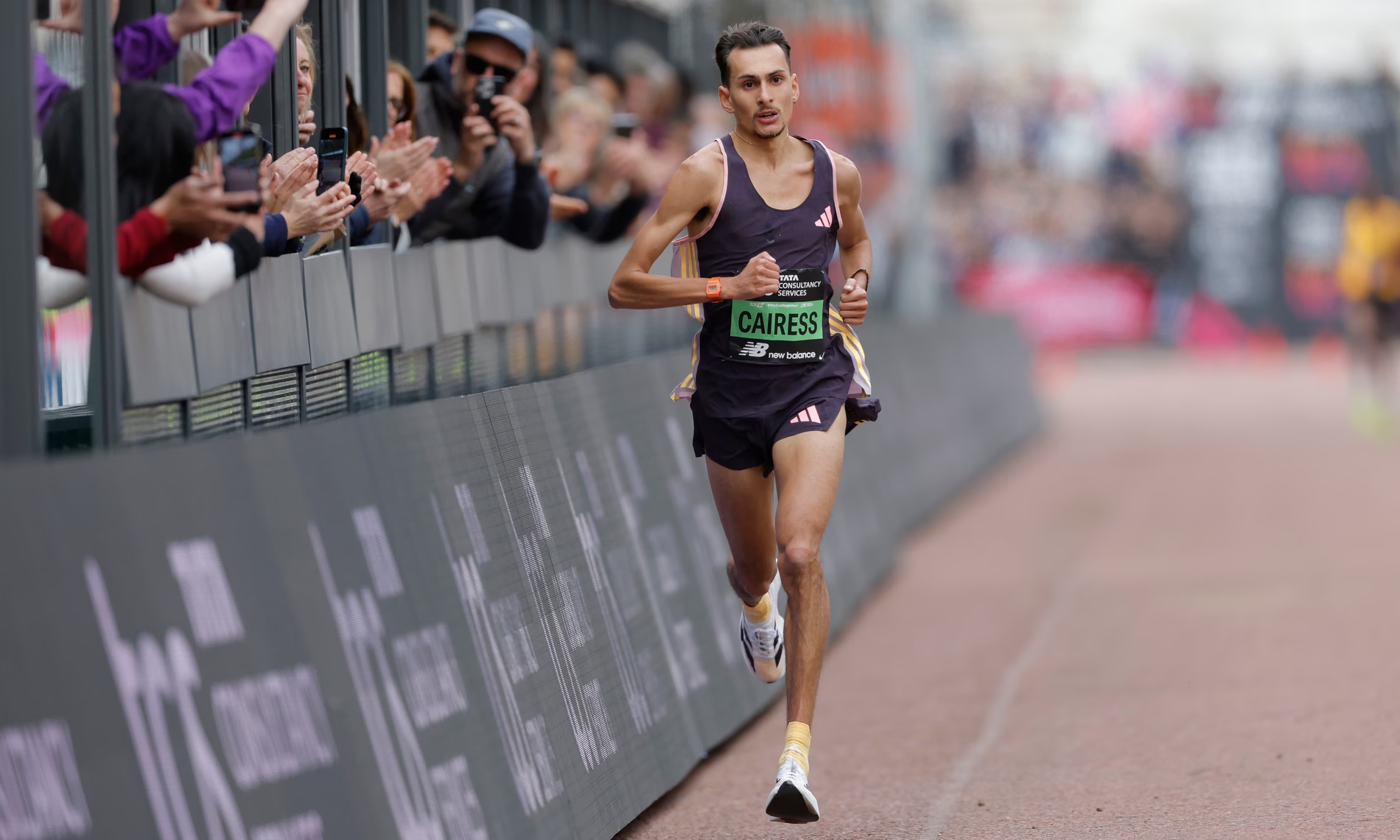
Emile Cairess on his way to third at the 2024 London Marathon, racing on a plain watch. Photo: BBC.
When Emile Cairess finished third at the 2024 London Marathon—booking his ticket to the Paris Olympics and becoming the second-fastest British marathoner in history, behind only Mo Farah—the most telling detail of his race wasn’t his time. It was his wrist.
While his rivals raced against the data streaming from their wrist-computers—algorithmic pacing, real-time cardiac drift, theoretical output limits—Cairess is known for doing the opposite. He races on a plain Casio and deliberately keeps himself in the dark about his own pace. "While I’m running I’ve not really got any idea of the pace," he told the Runner’s World podcast, adding that "it’s good for you mentally to be a bit disengaged sometimes, rather than feeling stressed about things that don’t need to be stressed about." He runs by feel, trusting the one computer that millions of years of evolution have finely tuned to read the body: the brain.
The modern endurance athlete has been trained to do the exact opposite. We have been conditioned to outsource our intuition to an algorithm, fixating on the scores our watches feed us. VO2 Max began as a rigorous clinical metric—but it became the gamified centerpiece of running culture for a simple reason: it’s a single, intuitive number that feels scientific and that you can watch climb. That makes it easy to understand, easy to market, and easy to obsess over. The catch is that leading with the most engaging metric pushes the more decisive ones—Lactate Threshold (LT2), running economy, and how the run actually feels—into the background.
Every Generation Gets a New Hero Metric
To understand how a century-old lab metric became the centerpiece of modern running culture, it helps to follow the economics of wearable technology. Companies like Garmin genuinely advance the field—they fund research, employ sports scientists, and have put real physiology on millions of wrists. Having more and better metrics has undeniably been a net positive for running, and it has helped expand the sport tremendously. But the metric that becomes the headline number on a new watch is shaped as much by what a wrist sensor can measure, and a marketing team can sell, as by what matters most to your training.
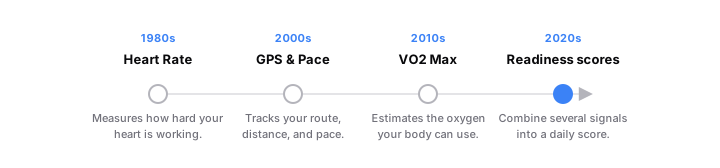
The headline number keeps changing as watches compete on software, not sensors.
The first hero metric was Heart Rate. When optical sensors reached the wrist in the mid-2010s, the appeal wasn’t accuracy—a chest strap still reads your heart more precisely than any wrist sensor—it was convenience: continuous, passive, all-day data you never had to think about. That trade, precision for convenience, set the template for everything that followed. And useful as it is, heart rate is only an input: it tells you how hard your heart is working, not the metabolic cost of the effort.
Next came GPS and pace. Mapping your route and tracking your splits was genuinely transformative, and for many runners it still is. But pace is an external output—it tells you what you did, not what it cost you internally. Two runs at the same pace can place very different demands on the body depending on heat, fatigue, terrain, and fitness.
By the 2010s, the core sensors had become table stakes. GPS had been on runners’ wrists since the Garmin Forerunner 201 in 2003, and optical heart rate was standard by around 2015. The hardware kept improving—better batteries, brighter screens, more accurate sensors—but the basic capabilities were now in every watch. To justify the next $600 upgrade, companies had to compete on software and insight, not just sensors. They needed a number that felt elite, scientific, and personal.
The landmark moment came from an algorithm, not a sensor. Garmin had been licensing physiological models from a Finnish company, Firstbeat, since 2011, and in 2014 the Forerunner 620 became its first watch to estimate VO2 Max from an ordinary run. In 2020, Garmin acquired Firstbeat Analytics outright—effectively buying the algorithm layer that turns raw heart-rate and pace data into the scores on your watch face.
It was a shrewd bet, and it paid off. In 2007, roughly three-quarters of Garmin’s revenue came from car GPS units—a business that smartphones with free navigation would soon gut. The company reinvented itself around the wrist, and metrics like VO2 Max were central to the pitch:
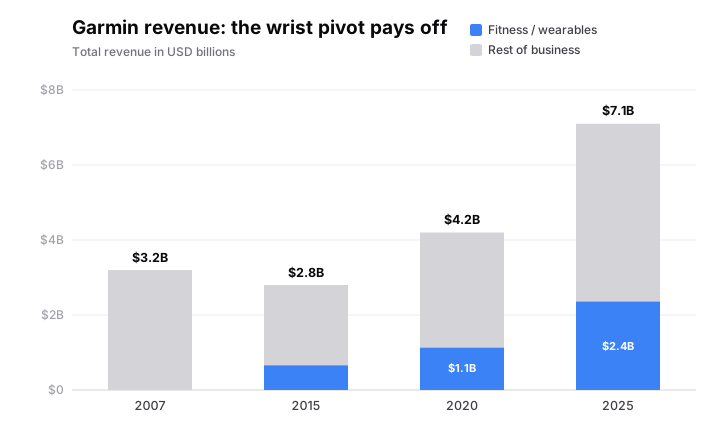
Sources: Garmin SEC filings (FY2007, FY2015, FY2020) and 2025 full-year results. 2007 car-GPS revenue was ~74% of the total; today it’s the company’s smallest segment.
Today that pivot is accelerating into a fourth generation of scores—Training Readiness, Body Battery, HRV Status—that bundle several signals into a single daily verdict on whether you’re ready to perform. These are the most opaque numbers yet: it’s rarely clear what goes into them or what to do about them. They deserve their own scrutiny, and we’ll come back to them in a follow-up piece.
From the Lab Bench to the Wrist
What’s easy to forget is that wearable companies didn’t invent VO2 Max. It was first described in 1923 by British physiologists Archibald Hill and Hartley Lupton as a rigorous laboratory method for measuring the ceiling of the human cardiorespiratory system.
For decades, finding your VO2 Max required a treadmill, a mask, and careful gas-exchange analysis to measure the exact volume of oxygen your body could consume at maximum exertion. It was a clinical metric, largely reserved for Olympic labs and medical research.
Wearables made that lab number accessible to everyone—a genuine achievement—but the number on your wrist is an estimate, not a measurement. It infers your VO2 Max from the relationship between your heart rate and your pace: run a little faster at a slightly lower heart rate, and the score ticks up. As a long-run trend line, that’s genuinely useful. It’s also satisfying to watch climb, which is exactly what makes it such good marketing—and what makes it easy to treat a rough estimate as if it were lab-grade truth.
What the Ceiling Actually Measures
The word "ceiling" is doing real work here, and it is worth being precise about what sets it. In 2000, exercise physiologists David Bassett and Edward Howley pulled together seventy-five years of evidence into what is still the definitive review of the question, and their answer is unambiguous: in a healthy person running all-out at sea level, VO2 Max is limited by how fast the heart and blood can deliver oxygen to the muscle, not by how much the muscle can consume. Roughly 70 to 85 percent of that ceiling traces to one thing, maximal cardiac output, with the oxygen-carrying capacity of the blood accounting for most of the rest.
This is why VO2 Max moves in the ways it does. Add red blood cells through altitude training or blood doping and it rises; thin the blood or blunt the heart rate with beta-blockers and it falls. It is a supply number. And it behaves like one in training: it climbs for the first couple of months of consistent work, then flattens. The improvements that keep arriving after that plateau are not the engine getting bigger. They are the other two drivers, the ones that never make it onto your watch face.
What the Number Leaves Out
By gamifying VO2 Max into the ultimate fitness score, the industry elevated one measure of aerobic capacity above all others. But ask any physiologist, and the answer is the same: engine size isn’t everything.
In 1991, physiologist Michael Joyner modeled the classic framework for distance running, showing that VO2 Max is only one of the "Big Three" determinants of endurance performance. Bassett and Howley later formalized the same picture from the measurement side, and their conclusion matters: for real races, your ceiling sets the upper limit on energy production, but it does not decide the result. The other two determinants do most of that work, and they rarely make it onto your watch face—not out of malice, but because they’re far harder to capture from the wrist.
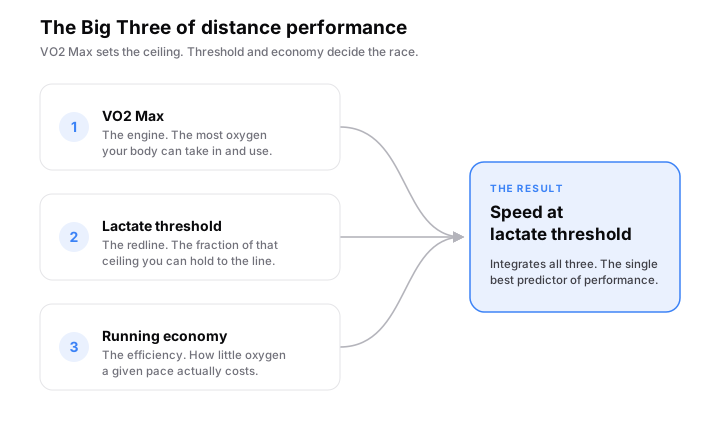
Race performance comes from three trainable drivers, not one. Adapted from Bassett & Howley (2000) and Joyner (1991).
The first is Running Economy—your fuel efficiency, or the oxygen cost of holding a given pace. Two runners with identical VO2 Max can perform very differently; on the same engine, the more economical one is faster. In the studies Bassett and Howley reviewed, economy varied by around 20 percent even among runners of similar ability, more than enough to separate a winner from the field. Most wearables can’t measure it, because doing so properly takes biomechanical analysis or laboratory gas-exchange data.
The second, and arguably most decisive, is Lactate Threshold (LT2)—your sustainable redline. LT2 is the intensity at which blood lactate starts to accumulate faster than your body can clear it: hold just under it and you can race for about an hour; push past it and fatigue builds quickly. It also captures the fraction of your ceiling you can actually hold, which is itself trainable and keeps improving long after VO2 Max has plateaued. That is why Bassett and Howley single out the speed at lactate threshold as the single best physiological predictor of distance-running performance: it folds all three drivers into one number, the ceiling, the fraction of it you can sustain, and how economically you run. To their credit, the better watches do estimate it—Garmin surfaces a lactate-threshold pace and heart rate, and is expanding the feature—but it tends to live a few menus deep, behind a specific hard effort, rather than on the watch face. It’s simply harder to estimate well: without a blood test, it takes careful modeling of your pace and heart-rate data, so it rarely gets top billing.
VO2 Max leads because it’s easy to estimate and easy to love. The metrics that matter more are simply harder to put on a wrist.
The Number Is an Input, Not a Verdict
The risk isn’t the data itself—it’s letting a single number override everything else. A VO2 Max score that drifts up and down day to day can quietly train you to trust the watch over your own legs. It’s common to see runners arrive at a start line feeling strong, then talk themselves out of an ambitious pace because their watch flashed a lower number that morning.
Data is only half the equation. Sports science leans heavily on Rating of Perceived Exertion (RPE)—how an effort actually feels—and good coaching has always combined the two. That side is the hardest to digitize, because a feeling doesn’t reduce neatly to a score, so it tends to get left off the dashboard entirely.
None of this means VO2 Max is worthless—tracked over months, it’s a perfectly good trend line. It means a single, gamified number shouldn’t be the loudest voice in your training. The lesson of Emile Cairess’s Casio isn’t that data is bad; it’s that the athlete, not the algorithm, should stay in charge. The runners who break through plateaus tend to be the ones who read the deeper metrics that actually drive performance and stay honest about how the run feels—treating the watch as an instrument, not an oracle. As Bassett and Howley put it in the definitive review of the science: “If any model could explain all of the variance in performance, gold medals would be handed out in the lab.”
References
- Hill, A. V., & Lupton, H. (1923). Muscular Exercise, Lactic Acid, and the Supply and Utilisation of Oxygen. QJM: An International Journal of Medicine, os-16(62), 135–171. doi.org/10.1093/qjmed/os-16.62.135 — the original definition of maximal oxygen uptake; 2023 marked its centenary.
- Joyner, M. J. (1991). Modeling: Optimal Marathon Performance on the Basis of Physiological Factors. Journal of Applied Physiology, 70(2), 683–687. doi.org/10.1152/jappl.1991.70.2.683 — the "Big Three" framework: VO2 Max, lactate threshold, and running economy.
- Bassett, D. R., & Howley, E. T. (2000). Limiting Factors for Maximum Oxygen Uptake and Determinants of Endurance Performance. Medicine & Science in Sports & Exercise, 32(1), 70–84. doi.org/10.1097/00005768-200001000-00012 — the definitive review: VO2 Max is limited by oxygen delivery (≈70–85% by maximal cardiac output), and the speed at lactate threshold, integrating all three "Big Three" drivers, is the best physiological predictor of distance-running performance.
- Garmin. Lactate Threshold — Running Science / Physiological Measurements. garmin.com. See also Wareable, "Garmin’s lactate threshold without a chest strap" wareable.com — confirms wearables do estimate LT2, even if it isn’t the headline number.
- Emile Cairess quotes via the Runner’s World podcast, as reported in "Emile Cairess: the heir to Mo Farah with a throwback approach to his sport," Olympics.com. olympics.com
- Garmin acquires Firstbeat Analytics (June 30, 2020); the two had partnered since 2011. Garmin Newsroom; analysis via DC Rainmaker.
- Garmin’s first on-watch VO2 Max estimate shipped on the Forerunner 620 (2014), powered by Firstbeat. the5krunner — Garmin VO2 Max.
- The Garmin Forerunner 201 (2003) was the first all-in-one GPS running watch. Garmin — Twenty Years of Running; Wikipedia — Garmin Forerunner.
- Garmin revenue & segment data — SEC filings (FY2007 automotive ≈$2.34B / ~74% of revenue; FY2015 fitness $662M; FY2020 fitness $1.13B) via SEC EDGAR, and 2025 record results (fitness $2.36B, +33% YoY) via Sporting Goods Intelligence.